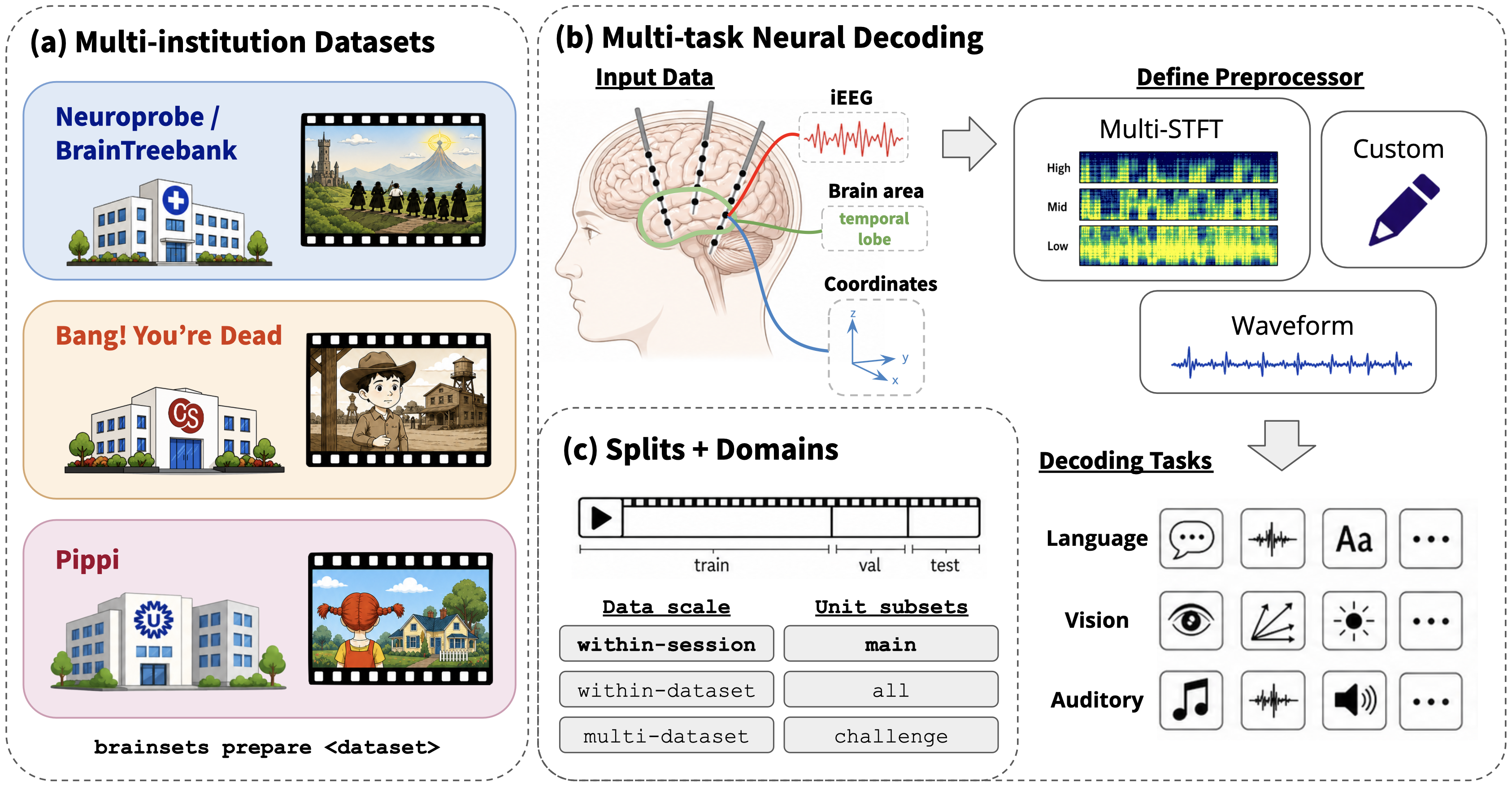
iMINDBench provides a multi-institution, multi-task, preprocessor-structured benchmark to evaluate iEEG Foundation Models' ability to benefit decoding regardless of recording institution or task, under comparable preprocessing tracks.
3 datasets and institutions 15 aligned decoding tasks 2+ preprocessing tracks
Benchmark Design
Three naturalistic datasets, explicit preprocessing tracks, and multiple decoding tasks spanning language, vision, and auditory tasks.
Dataset Diversity
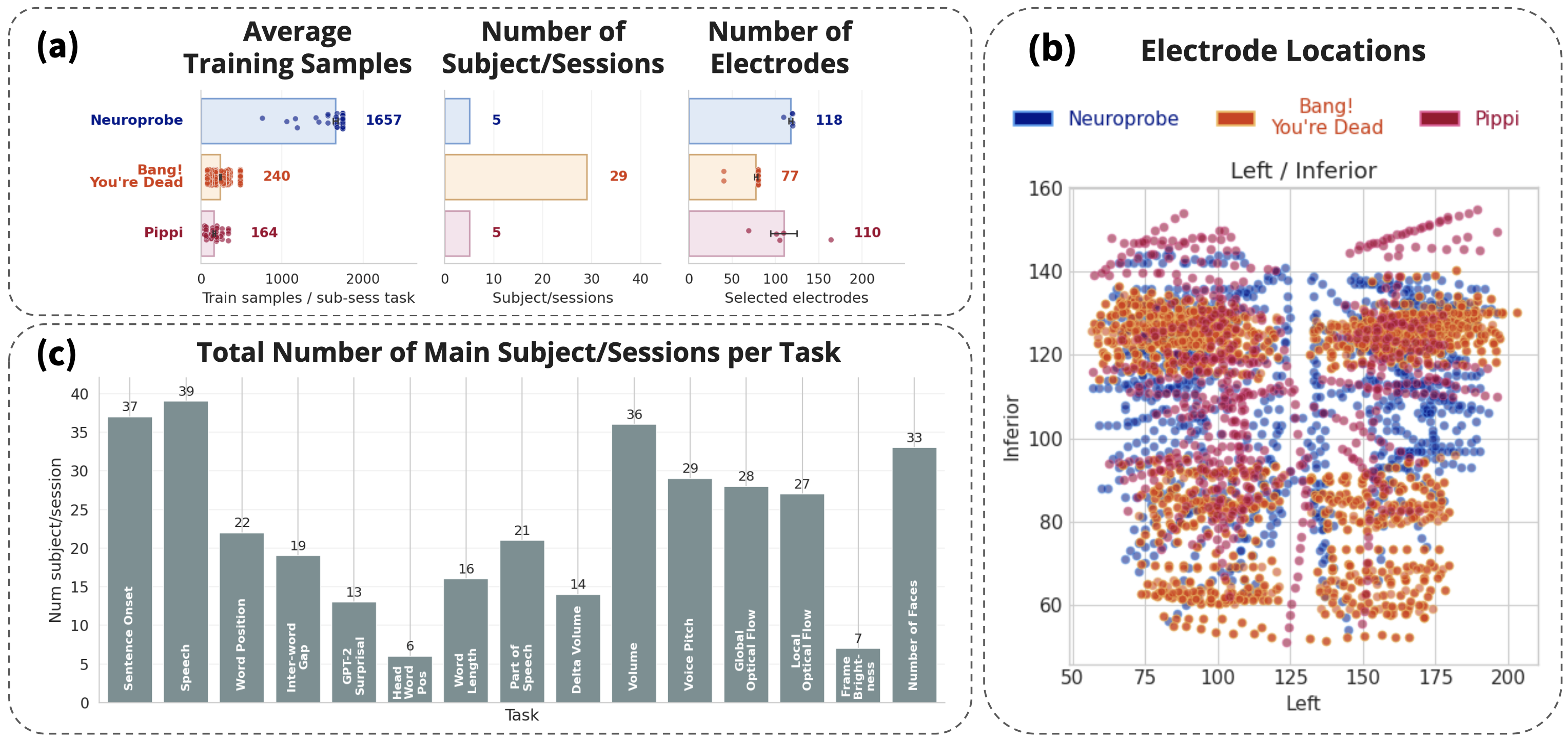
Scale, task support, and electrode coverage vary substantially across the benchmark as expected from multi-institution datasets.
BibTeX
@misc{chau2026imindbench,
  title={{iMINDBench}: {iEEG} Multi-Institution Neural Decoding Benchmark},
  author={Geeling Chau and Saba Hashemi and Yonghyeon Gwon and Eshani Patel and Jan DeWitt and Christopher Wang and Andrii Zahorodnii and Sabera J Talukder and Danny Dongyeop Han and Chun Kee Chung and Maryam M Shanechi and Yisong Yue},
  year={2026},
  eprint={2609.18104},
  archivePrefix={arXiv},
  primaryClass={cs.LG},
  url={http://arxiv.org/abs/2609.18104},
}